Understanding the split
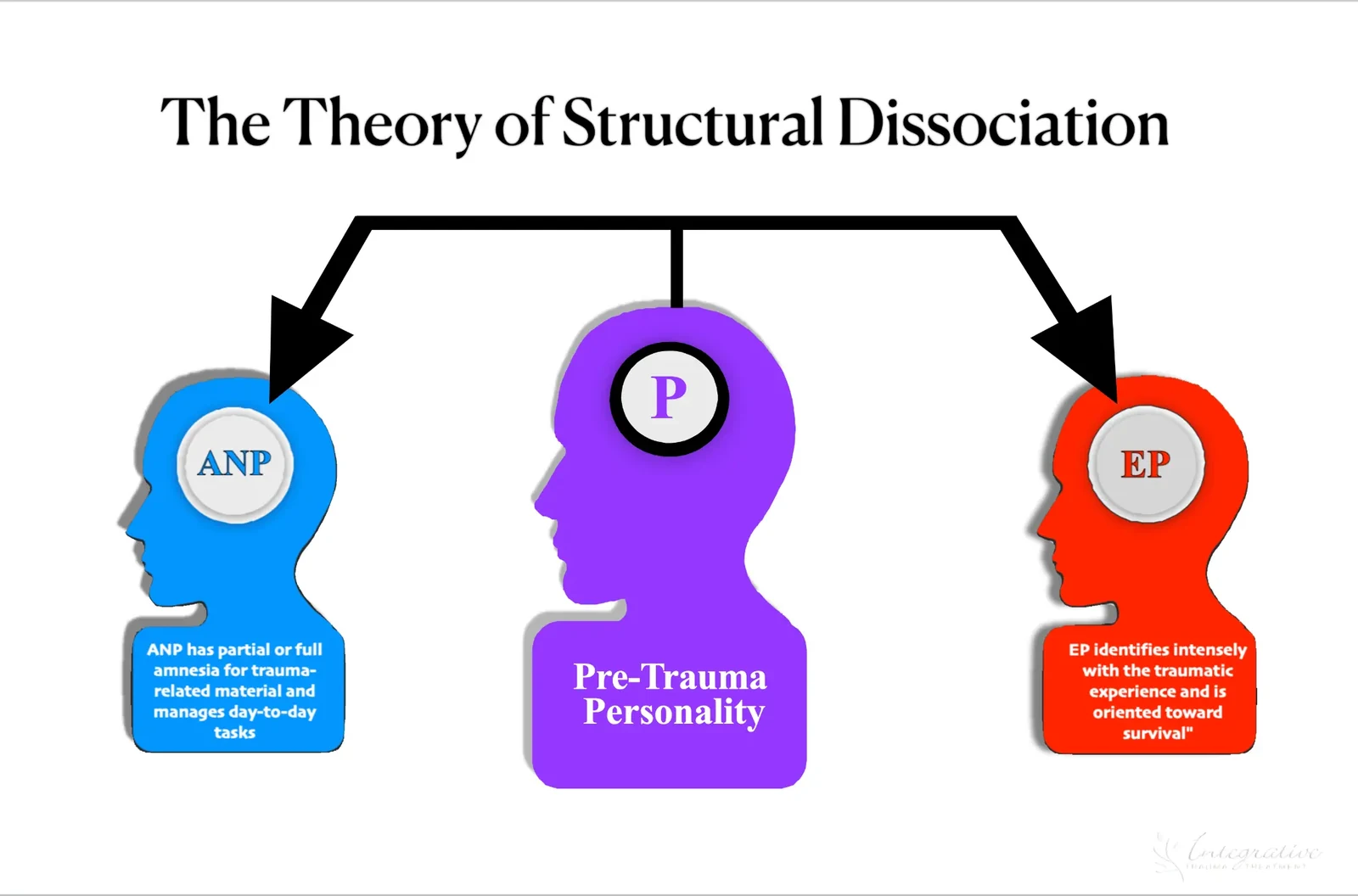
The Theory of Structural Dissociation of the Personality (TSDP) ~ developed by Onno van der Hart, Ellert Nijenhuis, and Kathy Steele ~ explains how trauma divides the personality rather than simply wounding it. It runs a single thread from PTSD through Complex PTSD to DID: the same mechanism, different degrees.
The personality splits into two kinds of parts. The Apparently Normal Part (ANP) handles daily life and steers clear of the trauma. The Emotional Part (EP) holds the memory, the affect, and the survival responses. Between them sits a dissociative barrier built of phobic avoidance ~ the ANP is afraid of the EP, and often of its own inner experience.
The ANP / EP model
Knowing which part is in the room tells you what the work is. You stabilize and befriend the ANP; you contact and reassure the EP. Pushing the EP forward before the ANP can tolerate it is how sessions destabilize.
Daily functioning, avoidance

- Manages daily functioning
- Avoids trauma-related stimuli
- Maintains social and occupational roles
- May feel emotionally numb
- Focused on present tasks
- May deny or minimize the trauma
- Phobia of trauma-related content
- Phobia of inner experience
Holds the trauma

- Holds the traumatic memories
- Carries trauma-related emotions
- Activated by triggers
- Re-experiencing symptoms
- Intense emotional reactivity
- May feel stuck in trauma time
- Fight / flight / freeze responses
- Submission and attachment cry
Three levels of structural dissociation
The model scales. One ANP and one EP is primary dissociation ~ classic PTSD. Add EPs and you reach secondary; add ANPs and you reach tertiary. The level dictates the treatment arc.
A single ANP manages daily life while a single EP holds the traumatic memory. The personality is divided into two parts.
Clinical focus: Standard trauma processing, resource development, integration of a single trauma memory.
One ANP manages functioning while multiple EPs hold different traumatic memories or aspects of the trauma. Common in chronic childhood trauma.
Clinical focus: Phase-oriented treatment, stabilization first, careful titration, working with EPs sequentially.
Multiple ANPs and multiple EPs, each with distinct roles, identities, and functions. Results from severe, early, chronic trauma.
Clinical focus: Extended stabilization, system mapping, internal communication, very gradual integration work.
Assessing dissociation
Undetected dissociation is the most common cause of destabilization in trauma processing. Screen before you process, diagnose when the screen flags concern, and monitor in real time once you're in the work. The questionnaires below live on the Screenings page.
Screen first, always
If there are parts, you need to know who they are and whether they consent before you begin memory work. Processing without consulting all parts will very likely destabilize the system.
Session language
How to ask about parts, how to speak to the ANP and the EP, and how to invite communication across the barrier.
- Do you ever feel like there are different parts of you that have different feelings about things?
- Sometimes people describe feeling like they're watching themselves from outside. Does that ever happen to you?
- Is there a part of you that feels one way about this, and another part that feels differently?
- When you think about that memory, do you notice any part of you that wants to avoid it?
- I'm noticing the part of you that manages daily life might be feeling protective right now.
- It makes sense that part of you wants to keep going and not think about this.
- That part has been working hard to help you function. What does it need right now?
- Can we acknowledge how much this part has helped you survive?
- I'm wondering if there's a younger part that's holding some of these feelings.
- That part that's feeling so scared ~ does it know how old you are now?
- Can we let that part know it's safe to share just a little bit at a time?
- What does that emotional part need to feel safer right now?
- Can the part that manages daily life and the part that holds these feelings begin to communicate?
- What would it be like if all parts of you could share the same timeline?
- Is there a way these different parts could work together rather than against each other?
- What would integration look like for your system?
References
- Van der Hart, O., Nijenhuis, E. R. S., & Steele, K. (2006). The Haunted Self: Structural Dissociation and the Treatment of Chronic Traumatization. Norton.
- Steele, K., Boon, S., & Van der Hart, O. (2017). Treating Trauma-Related Dissociation: A Practical, Integrative Approach. Norton.
- Nijenhuis, E. R. S. (2015). The Trinity of Trauma: Ignorance, Fragility, and Control. Vandenhoeck & Ruprecht.
This material is covered in The EMDR Deconstructed Workbook, Chapter 3: Foundations. See the workbook page.